Hi there,
Look — I want to show you something most people don’t know their dentist can do.
For most of my career, gum disease got treated like one condition. You either had it or you didn’t. Gums bleed, we clean more often, we hope it settles down. Twenty-seven years of that, and to be honest with you: sometimes it worked and sometimes it didn’t, and I couldn’t always tell you why.
Turns out there was a reason.
Gum disease isn’t one thing
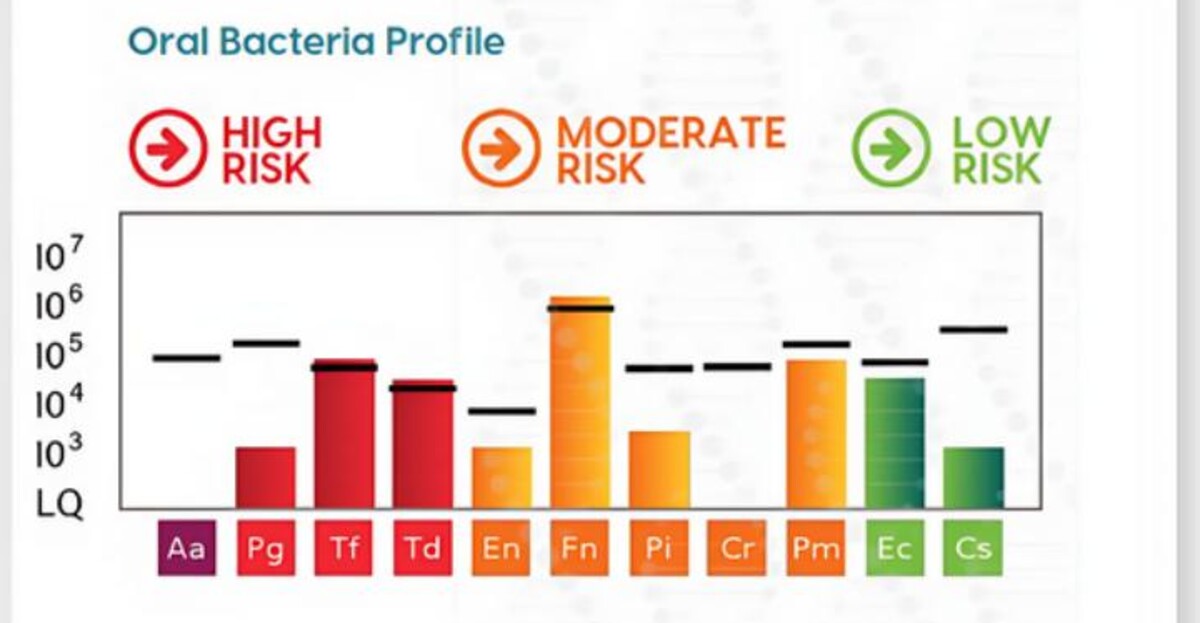
There are eleven bacteria known to be involved. They are not equal. Four of them are the aggressive ones — Porphyromonas gingivalis, Tannerella forsythia, Treponema denticola, Aggregatibacter actinomycetemcomitans. (Yes, those are the real names. No, I can’t say them quickly either.) The rest sit in moderate and low-risk tiers.
Two people can sit in my chair with gums that look identical and be carrying completely different bacteria. Same puffiness. Same bleeding. Different problem underneath.
So we stopped guessing. It’s a rinse — swish, spit, off to the lab. What comes back is a chart showing which of those eleven live in your mouth, and at what levels.
Your genes get a say
There’s a gene called interleukin-6 — IL-6 — involved in how your immune system runs inflammation. The same test reads it. Three possible results: G/G, G/C, C/C. G/G tends to mean your body mounts a stronger inflammatory response to the same bacteria everyone else is carrying.
Same bugs. Two people. One of them inflames harder. That isn’t effort and it isn’t something you did wrong. It’s how you were built.
And you only need that one once. Your genes don’t change. We read it a single time in your life, and then we know.
Same bacteria, same brushing, different outcome. That’s not willpower. That’s biology — and now it’s readable.
What actually changes when we know
This is the whole point.
If I know which bacteria you carry and how your body answers them, the plan stops being generic. Someone carrying the aggressive four with a high-response genotype gets watched more closely and treated more actively — tighter recall, sometimes prescription gel delivered below the gum line at home between visits.
And someone with a low-risk profile doesn’t need any of that, so I’m not going to put them through it. Being able to tell you you don’t need this matters to me as much as being able to tell you that you do.
That’s what I mean when I say we don’t guess when we don’t have to.
It doesn’t stop at the mouth
Bacteria are only half of healing. The other half is what your body has to work with.
So we also pay attention to bloodwork — inflammation, blood sugar, and the nutrients tissue is literally rebuilt from. If you’ve had labs run in the past year, bring them in. There are about ten numbers on an ordinary panel that tell me a great deal about how your mouth is going to heal.
One example. hs-CRP is a general inflammation marker. Under 1.0 is where we like to see it. Above 3.0 and something is actively inflamed somewhere, and gum tissue will have a harder time settling no matter how well I treat it.
Those ten deserve their own note, so that’s the next one.
None of this diagnoses anything. We’re a dental office and I’d never pretend otherwise — it’s information, read alongside the rest of your health picture. But it’s information almost nobody has been offered by a dentist, and that’s the part that still bothers me.
There’s no offer in this email.
If you’re curious, ask me at your next visit — “what does the saliva test actually tell you?” — and I’ll pull up a real report and walk you through it. Takes about five minutes.
And if it’s been a while since you’ve been in, that’s fine. No lecture. Whenever you’re ready.
We’re here to guide you to a better and stronger version of yourself.
|
Dr. Irwan Goh
Smiles by Goh · Henderson, NV
|