Now welcoming new patientsServing Henderson
Emvital® · BTL Industries

Ease the muscle,
settle the jaw.

You wake with a tight jaw. Soreness at the temples, an ache that’s there before the day starts, a clench you can’t seem to put down. We go after the muscle driving it — not the bite first. EMFACE® retrains the jaw muscle and carries the TMD work; the Emvital® laser may help ease the soreness and tension alongside it. Most plans here use both.

See the protocol
Device
Class-4 therapeutic medical laser1064 + 635 nm photobiomodulation
Session
~10–20 min · no needlesContactless or handheld · no downtime
Paired with
EMFACE®Muscle work · the structural half
Used at SBG for
Muscle reliefTemporary easing of jaw-muscle soreness
01 — Why we use it

Most TMD work starts
at the splint.
We start at the muscle.

Look, the morning soreness, the clench, the temple ache — that’s a muscle working too hard, not a joint that’s broken. If the muscle is locked, no splint is going to teach it to relax. The bite-plate route assumes the joint is the problem. In most patients we see, it isn’t.

EMFACE® brings the muscle back into balance. The Emvital® laser offers temporary relief from the soreness that over-worked muscle has been feeding. Only after both are calm do we look at the occlusion. That’s a different conversation, with a different chance of working.

“The bite isn’t always the problem. We rule the muscle in before we rule the bite out.”— Dr. Irwan Goh
01.01 · The pairing

Emvital
+ EMFACE®.

EMFACE® rebalances the muscle and carries the TMD work. The Emvital® laser eases the muscle soreness alongside it. Most cases here use both, because each one supports a different part of the problem.

01.02 · The order

Tissue first,
bite last.

If a splint, orthodontics, or restorative work belongs in the plan, it lands after the muscle is calm — not before. We don’t paper over a hypertonic system with hardware.

01.03 · What you’ll feel

Gentle laser,
then release.

The laser is mild — light warmth at most. The EMFACE® side feels like a deep, rhythmic pulsing as the muscle contracts and releases. Many patients notice morning jaw soreness easing in the early sessions.

Dr. Goh at work · operatory · or session footage
Soft tissue calms before the bite gets touched
02 — How it works

Two devices.
One plan.

Most TMD pain isn’t coming from the joint itself — it’s coming from the muscles around it doing too much, for too long, with too little recovery. EMFACE® carries the TMD work: it retrains the muscle and addresses the jaw joint. The Emvital® laser plays a supporting role — temporary relief for the soreness and tension in those over-worked muscles, plus a nudge to local circulation. Neither one alone is the whole answer.

Emvital® device · in-operatory
Emvital® · in-operatory

Emvital® laser.

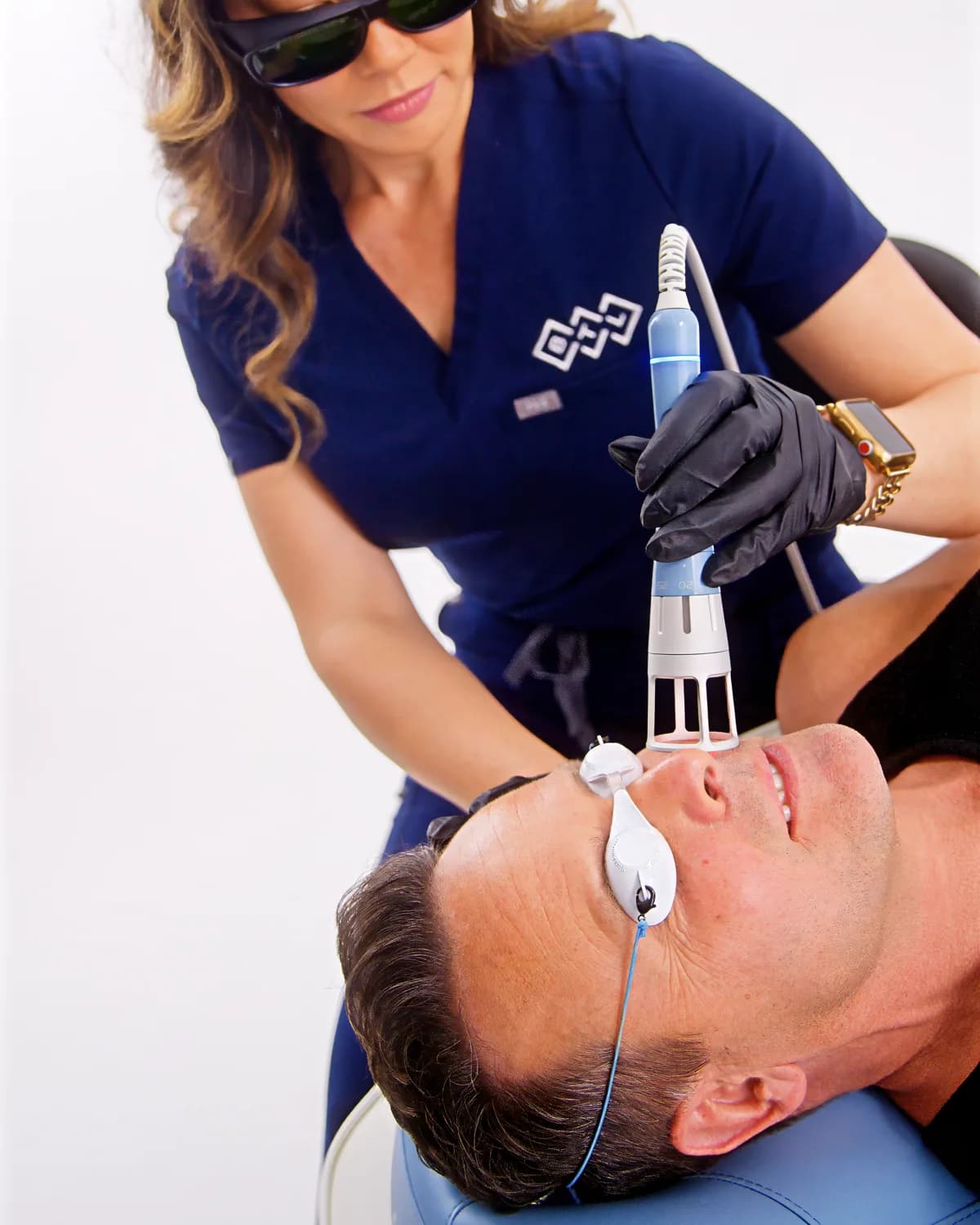
A Class-4 therapeutic medical laser delivers light at two wavelengths deep into the tissue — a process called photobiomodulation. Each session typically runs around 10–20 minutes, contactless or handheld, and is calibrated to your skin type. It may help give temporary relief to the tired muscles around the jaw, easing soreness and tension and encouraging local circulation — gently, without heat that you’d notice.

1064 + 635 nmTwo wavelengths

EMFACE® muscle work.

A separate device — radio-frequency plus high-intensity facial stimulation (HIFES™) — relaxes and retrains the masticatory muscles that have been over-recruited for years. This is the structural half of the plan.

RF + HIFESEMFACE® TMJ preset

Two roles, together.

EMFACE® retrains the muscle and carries the TMD work; the Emvital® laser eases the muscle soreness alongside it. They support different parts of the same problem, which is why most plans here use both rather than one.

2 devicesComplementary
03 — The protocol

Four steps,
measured at each one.

The TMD plan here is a measured course — not a series of indefinite sessions. We baseline, treat with both devices, re-measure, then decide whether to maintain or escalate.

i

Evaluate.

A TMD-focused exam — palpation of masseter, temporalis, and pterygoids; range-of-motion measurements; surface EMG if useful; CBCT review if it's clinically warranted.

Visit 01
ii

Calm the muscle.

EMFACE® works the jaw muscles directly — four sessions per zone, spaced two to fourteen days apart. It relaxes and retrains the jaw muscles that have been over-recruited for years.

EMFACE® · 04 sessions
iii

Ease the muscle.

The Emvital® laser supports the muscle side — therapeutic light delivered to the same region, used here for temporary relief of muscle soreness and stiffness and to encourage local circulation. Where it fits, we run it as a short series alongside the muscle work.

Emvital® · short series
iv

Re-evaluate, then maintain.

We re-measure jaw range, pressure tolerance, and the morning symptom log. If the muscle is calm, we move on. For severe joint involvement, we co-manage with a TMJ specialist — these devices are part of the plan, not the whole plan.

After the series

What a session looks like.

EMVITAL session · portrait
Neck-region treatment
Emvital® unit · neon atmosphere
EMVITAL session · portrait
Jaw-region treatment
EMVITAL session · wide
EMVITAL session · low-key portrait
Emvital® unit · light wide
Neck-region treatment
EMVITAL session · portrait
Jaw-region treatment
Emvital® unit C026
04 — Is it for me?

An honest fit, or not.

This two-device approach works well for most muscle-driven jaw pain. Not every case. We’ll tell you honestly when it isn’t the right path.

Yes, if —

  • You wake with jaw soreness, headaches, or temple tension most mornings.
  • You clench or grind, and the night-guard hasn’t moved the needle.
  • Splint therapy worked, then the symptoms came back.
  • You want a path that doesn’t start with injections or surgery.

Probably not, if —

  • You have a confirmed structural joint problem — we’ll refer.
  • You have a pacemaker, defibrillator, or metal implants near the area.
  • You’re pregnant.
  • You want a one-and-done visit.
05 — Investment

Three ways to begin.

We don’t publish a flat fee — the right entry depends on what we find at evaluation. Every consult ends with a written, itemised quote. CareCredit, Cherry, LendingPoint, Sunbit, and our BoomCloud in-house savings plan available.

Trial
One session.

Feel the laser before committing to anything more. Includes the evaluation and a single treatment.

  • TMD-focused evaluation
  • One Emvital® laser session
  • Best for: testing before you commit
Recommended
The TMD plan.

Where most patients land — the muscle retraining and the muscle-relief work together. EMFACE® carries the TMD work, the Emvital® laser eases the soreness alongside it, then a structured re-evaluation.

  • TMD-focused evaluation
  • EMFACE® muscle sessions + Emvital® laser series
  • Re-evaluation built into the plan
Laser only
Emvital
laser series.

For patients whose plan calls for the muscle-relief work on its own, or as an add-on to muscle therapy already underway.

  • Evaluation
  • A short series of Emvital® laser sessions
  • Re-evaluation before we continue

Emvital® is a therapeutic laser and EMFACE® is a wellness device, both used here in a dental context as part of TMD care. They aren’t a replacement for diagnosis and treatment of acute joint pathology — we refer for that.

06 — Questions

The honest answers.

Emvital® is a Class-4 therapeutic medical laser. It delivers light at two wavelengths — 1064 and 635 nanometres — into the tissue, a process called photobiomodulation. Here it does one job: temporary relief of the muscle tension and soreness around the jaw, and a nudge to local circulation. The TMD work itself — the muscle retraining and the jaw joint — is carried by EMFACE®.
Different tool, different job. EMFACE® uses radio-frequency and muscle stimulation to relax and retrain the jaw muscles — it carries the TMD work, the jaw joint and the structural side. The Emvital® laser is the muscle-relief adjunct: temporary easing of soreness and tension, and a nudge to local circulation. In most plans we use both together, because they support two different parts of the same problem.
Not necessarily. Some patients still benefit from a guard while the muscle resets; others don't need one once the upstream tension is gone. We re-evaluate as the plan progresses and adjust.
Many patients report easier mornings — less jaw soreness on waking — within the first few sessions. Comfort tends to keep building as the muscle work and the laser work do their separate jobs. Everyone's timeline is different, and we track yours honestly.
The laser is gentle — most patients feel mild warmth and nothing more. Every session starts on the gentlest preset and is dialled to you from there; the device has three comfort settings (Gentle, Balance, and Advance) and is calibrated to your skin type before we begin. Sessions typically run around 10–20 minutes. The EMFACE® side feels like a deep, rhythmic pulsing as the muscles contract and release. There's no needle, no incision, and no downtime with either.
Dr. Goh leads every TMD evaluation. The sessions themselves are run by Dr. Goh or our trained clinical team, depending on the visit.
Let’s talk

Start with a
TMD evaluation.

Twenty unhurried minutes — palpation, range-of-motion, a careful conversation about how your jaw feels in the morning. No commitment to start the course.

What brings you in?
Consults only · Henderson, NV

facial rejuvenation, jaw & TMJ

Patient
Your details
Optional · speeds up booking
You’re requesting EMFACE & Emvital as a new patient.
Call · 702 · 732 · 3754