Now welcoming new patientsServing Henderson
Restorative · Henderson, NV

Implant Restoration
in Henderson

Dr. Goh restores dental implants; the surgical step happens elsewhere. A titanium post goes into the jawbone, and an oral surgeon or a periodontist does that part. Smiles by Goh refers you to one and works alongside them. Everything above the bone is Dr. Goh's: the connector, the crown, and how your bite lands on it. So is what happens to it in the years after. If a post is already in and you need the tooth that sits on top of it, that is this visit.

What happens here
The abutment, the crown, the bite
The surgical step
An oral surgeon or a periodontist
Already have one?
A post put in at another office can be restored here
See the full menu of restorative care →
What an implant actually is

Three parts, and they are not all the same job.

Knowing which part is which tells you who you are seeing, and for what.

01 · The post

Titanium, in the bone

The implant itself is a small titanium post set into the jawbone, and it is the only part of this that is surgery. Bone grows directly onto its surface over roughly three to six months, which is why nothing final goes on top of it straight away. That step belongs to an oral surgeon or a periodontist. Dr. Goh refers it out rather than doing it here, and he will say so at the first visit.

Referred out · months to integrate
02 · The abutment

The connector nobody mentions

An abutment is the short piece that bridges the post below your gum and the crown above it. It is shaped to the height of your own tissue. The gum then closes around it in a collar instead of leaving a shelf where food can sit. Dr. Goh matches it to the system already in your jaw. That connection is not a universal thread, and the wrong part will not seat.

Matched to the system in your jaw
03 · The crown

The tooth you see, and the bite it takes

The crown is scanned, designed and fitted here. One thing separates it from an ordinary crown: how lightly it meets the tooth above. An implant has no ligament to give under load, so its contact sits a fraction shy of its neighbours. That is deliberate, and it is why the bite check on this appointment matters more than on almost any other.

Scanned, designed, fitted here
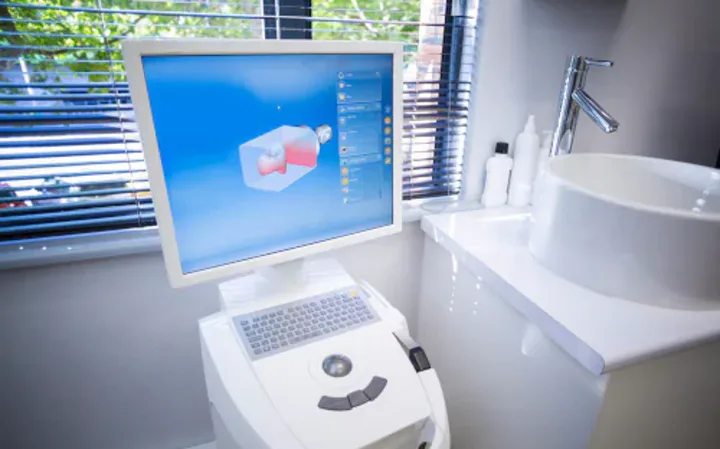
A chairside design station at Smiles by Goh with a restoration being shaped on screen
Designed to your bite
Why the restoration is not the easy half

A natural tooth is suspended. An implant is fused on.

Your own teeth do not sit rigidly in bone. Each one hangs in a thin ligament that lets it sink a fraction of a millimetre under a bite and spring back after. That ligament is also full of nerve endings, which is how you feel a popcorn husk before you break something on it.

An implant has none of that. Bone is knitted straight onto metal, so there is no give and no early warning. Force a real tooth would have absorbed goes into the bone instead. That is why the contact is set light, then checked again once things settle.

Who this page is for

Whether this is the right room for your case.

The honest sort here is about which stage you are at, not about whether you qualify for anything.

If the bone still has to heal, or no post is in yet, your first appointment is with a surgeon. The office helps you get to one rather than hold the case here.

  • A post is already in and needs its tooth

    Whether it went in last spring or six years ago, the abutment and the crown are made and fitted here.
  • An old implant crown that loosened, chipped or came off

    Bring the piece if you still have it. Which part gave out — the screw, the cement seal or the ceramic — changes the repair.
  • Sore or bleeding gum around an implant you already have

    That gets examined here and treated alongside the periodontal side of the practice. It is not something to wait out.
  • Anything surgical

    The post, bone grafting and gum surgery go to an oral surgeon or a periodontist. Dr. Goh restores; he does not operate.

Nobody can honestly put a number on how long yours will last, and the metal is not what decides it. Three things decide it. The first is the seal of gum around the abutment. The second is whether the bone underneath stays healthy. The third is whether your bite lands evenly on it, night after night — and those three are what the follow-up visits actually look at.

The honest answers.

No. The surgical step goes to an oral surgeon or a periodontist, and Dr. Goh refers you to one he works with. Everything after that — the abutment, the crown, the bite and the follow-up — happens here. Splitting a case that way is ordinary, and you should hear it said plainly rather than discover it halfway through.
Usually, yes, and it is a common reason people come here. The connection at the top of a post is not a universal thread. Each system has its own geometry, so the first job is working out which one is in your jaw. An X-ray normally shows it, and the surgeon's report or your old records settle anything ambiguous. Once the system is known, the matching abutment is ordered and the crown is built onto it.
Roughly three to six months in most cases, and the bone sets that schedule rather than anyone's diary. The surface of the post has to knit to living bone before it can carry a chewing load. Loading it early is one of the main ways an implant is lost. Your surgeon says when it is ready, and Dr. Goh takes it from there.
Because it is set up to. A natural tooth hangs in a ligament and sinks about a tenth of a millimetre when you bite down. An implant does not move at all. If its crown were adjusted to the same contact as the teeth beside it, it would take the first and hardest hit every single time. So it is left fractionally shy, then re-checked once your other teeth have settled around it.
Shade is the easy half; the harder half is the gum. Tissue sits differently around an abutment than around a natural root. The shape of that connector decides whether the crown emerges from a natural collar or from a flat shelf. Dr. Goh shapes it against the matching tooth on the other side of your mouth, and you see it before anything is final.
It can lose the bone around it, and that has its own name: peri-implantitis. It tends to move faster than gum disease around a natural tooth, and the reason is the attachment. Around your own tooth, fibres insert into the root surface and act like a gasket. Around an implant those fibres run parallel to the surface instead, so the seal against bacteria is weaker. That is why the periodontal side of this practice is part of implant follow-up rather than a separate department down the hall.
Yes — and around it more than through it. Plaque sitting at the junction of the abutment and the gum is what starts peri-implantitis. A water flosser, an interdental brush, or floss threaded around the collar all do the job. What matters is that the collar gets cleaned every day. An implant cannot decay, which is precisely why people relax about cleaning it and then lose it to the gum instead.
Call the office and bring it in. A screw-retained crown that has worked loose often needs the screw torqued again and the access hole re-sealed, which is a short visit. A cemented one that has come off needs the fit checked before anything goes back on. A crown that has been moving for weeks can change the tissue around it. Do not glue it back yourself — over-the-counter cement in that gap is difficult to clear out afterwards.
Not always, and that is worth hearing from someone who does not perform the surgery and does not bill for it. A bridge uses the two teeth either side of the gap and finishes in two visits. An implant leaves those teeth untouched, but it needs a surgical step and months of healing first. Where the neighbouring teeth already carry large fillings or crowns, a bridge costs you less structure than it sounds like it does. Dr. Goh lays both out with your own scan on the screen.
Smiles by Goh does not publish prices. With an implant there is a second reason on top of the usual one: part of the cost is not ours at all. The oral surgeon or periodontist bills the surgical step separately, so a figure from this office covers the abutment, the crown and the visits. Here is what you can count on. The recommendation gets written down and itemised before anything starts, and the office checks what your plan covers rather than guessing from the card.
Request an implant restoration consult

Bring the post you already have, and let's finish it.

Twenty unhurried minutes with the imaging that matters. You leave knowing which system is in your jaw and what the crown on top of it involves. If nothing is in yet, you leave knowing whether an implant is even the right answer for that gap. Written down and itemised, with no pressure to start the same day.

Hours rotate every two weeks — call to confirm today's hours.

Financing available — CareCredit · Cherry · LendingPoint · Sunbit · BoomCloud in-house savings plan

What brings you in?
Consults only · Henderson, NV

your first full visit — whole-body, oral-systemic health

Patient
Your details
Optional · speeds up booking
You’re requesting Comprehensive Wellness Consult as a new patient.
Call · 702 · 732 · 3754