
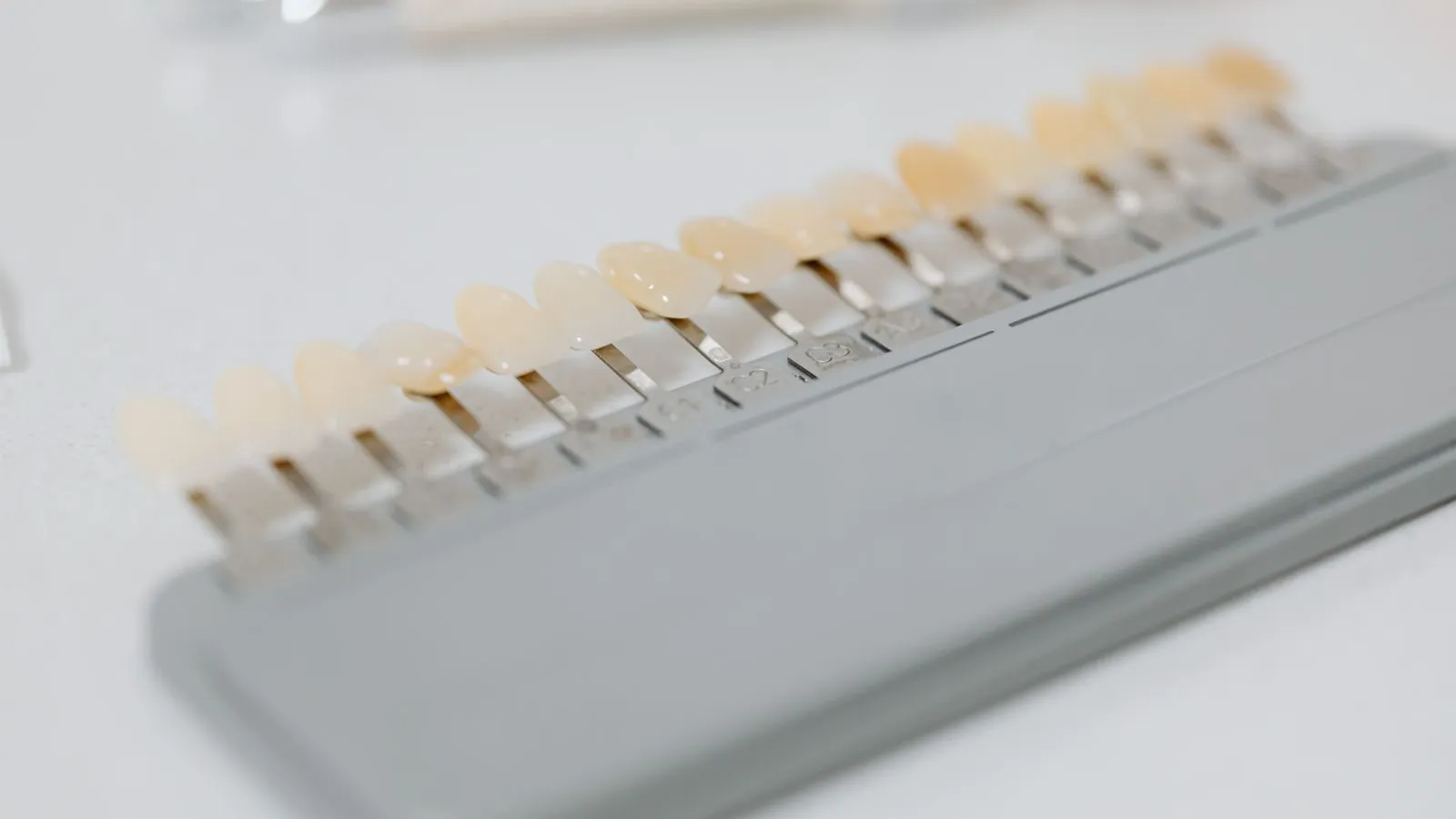
You have a box of whitening strips in your cart, or you are standing in the aisle holding one. You have also seen dentists offer whitening, so the question is a fair one. When it comes to professional teeth whitening vs strips, is there a real difference, or are you paying more for the same peroxide?
To be honest with you, it is the same family of chemical, and peroxide is what does the whitening in both. What differs is how strong the gel is, how long it sits on each tooth, and how well it fits your mouth. It also matters whether anyone checks what your color is made of before you start. Those four things decide the result, and they decide how sensitive your teeth get along the way.
How does whitening actually change the color of a tooth?
Whitening does not scrub a stain off the surface. The peroxide breaks down and passes through the enamel into the dentin underneath, the inner layer that gives a tooth most of its color. There, it breaks apart the larger colored molecules that make a tooth look darker. So the change you see happens inside the tooth, not on its surface.
Two kinds of peroxide show up on labels, and they are not equal by the number. Hydrogen peroxide works directly. Carbamide peroxide releases about a third of its content as hydrogen peroxide, per the American Dental Association's review of tooth whitening. So a percentage on a box only tells you something once you know which peroxide it is.
Professional teeth whitening vs strips: is it the same peroxide?
Mostly, yes. The ADA notes that store products usually carry lower peroxide concentrations than the systems a dentist supplies for home use or applies in the office. Dentist-supplied home systems typically run from 10% to 38% carbamide peroxide, per the same ADA review.
Strength is not the whole story, though. A systematic review cited by the ADA found that lower hydrogen peroxide concentrations in the office caused less sensitivity and gave greater measured color change. Stronger is not automatically better. What counts is matching the dose and the time to the actual tooth in front of you. That is where strips and professional whitening part ways.
What a strip does
A strip is a thin film coated with gel and cut to one size for everyone. You press it onto your front teeth and wear it for the time on the box. Every tooth it touches gets the same dose for the same length of time. Where it lands on your teeth and gums depends on the shape of your mouth, not on the strip.
Some strips carry the ADA Seal of Acceptance, which means the maker showed the ADA the product is safe and effective when used as directed. Products a dentist supplies are not eligible for the Seal at all. That is a rule about the category, not a verdict on either one.
What changes when a dentist sets it up
Here, we take shade readings and look at where the color actually sits before choosing anything. Then we set the gel strength and the wear time to your teeth. For take-home whitening we use the Opalescence range, in trays molded to your own bite or in ready-made trays when you want to start sooner. For deeper, stubborn stain there is KöR, with custom trays worn overnight and an in-office session to finish. In the office we use Boost, a gel that works by chemistry alone, with no lamp and no laser.
A custom tray matters for a physical reason. The ADA describes trays made in the office to fit comfortably and to keep the gel off the gums. Gum irritation during whitening usually comes from trays that fit poorly or from gel that ends up in the wrong place.
Why do teeth get sensitive, and why does fit change that?
Sensitivity follows straight from the mechanism. Peroxide travels through enamel and reaches the dentin, and dentin connects to the nerve. The twinge you feel is the nerve responding to something that reached it, and it passes. Mild to moderate sensitivity shows up in up to two-thirds of users early in treatment, per the ADA review.
That is why the dose and the time matter more than the brand on the box. A strip cannot know that your gums have pulled back on one tooth, or that your teeth already run sensitive. When we set it up, we can start gentler and build up from there. The Opalescence gels also carry fluoride and potassium nitrate, which calms the signal the nerve sends.
What can whitening not do?
This is worth knowing before you spend money on any of it, strips included.
Crowns, veneers, bonding and fillings keep their color. They are porcelain or composite, so there is no dentin under them for peroxide to reach. If you whiten the teeth around an old front crown, you end up with a mismatch. When new work is on the way, we sometimes whiten first and then match the new work to the brighter shade.
Some stain lives deep inside the tooth. That kind responds differently from coffee or tea stain near the surface. Some of it lightens with a slower plan, and some of it does better with a different treatment, such as composite veneers.
Gel acts on the tooth, not on what sits on top of it. Plaque and tartar get in the way of the peroxide. If they are there, that comes first, at your periodontal visit.
The shade right after treatment is not the final shade. Teeth held open and dry look whiter straight away, because dried-out enamel turns opaque. Some of that brightness settles back as the teeth take up water again, so the shade a few days later is the real one.
It does not last forever. Coffee, tea, red wine and tobacco bring color back over time, and how fast depends on your habits. Take-home trays you keep make a short touch-up easy.
Which one makes sense for you?
Strips are a reasonable place to start if your teeth are healthy, evenly yellowed from coffee or tea, and not sensitive. It also helps if you have no crowns or fillings at the front. Follow the box, and stop if the sensitivity does not settle.
A dentist earns a place when any of that is not true. That means dental work in your smile line, teeth that already run sensitive, or gums that have pulled back. It also means stain that did not move with strips. A visit helps, too, when you want to know why your teeth are the color they are. The ADA review notes that an exam before bleaching helps find what is causing the discoloration.
For me, cosmetic work is not about having perfectly white teeth. It is really about confidence, the ability to smile without hesitation.
Common questions about whitening strips and professional whitening
Do whitening strips damage enamel?
Used as directed, the common side effects are temporary sensitivity and gum irritation. The ADA review also notes some research suggesting whitening can change the texture of the enamel surface. Wearing strips longer or more often than the box says gives the peroxide more time in the tooth, and that is how sensitivity builds.
Will strips whiten my crown or veneer?
No. Only natural teeth whiten. Crowns, veneers, bonding and fillings keep the shade they were made in. Whitening the teeth around them can leave that work looking darker by comparison.
Can I start with strips and come in later?
Yes. If strips did not move a stain, or they made your teeth sore, tell us what you used and for how long. That tells us something about where the color sits and how your teeth handle peroxide.
If you are weighing strips against a professional plan, or strips did not do what the box promised, come talk it through. You can read how we whiten on our teeth whitening page and see the rest of our cosmetic options. Our hours rotate, so call 702-732-3754 to confirm today's schedule, or book a visit online.